Taliya Minullina spoke at a round table at the "Energoprom" forum
A round table within the framework of the ENERGOPROM forum with JSC "Grid Company" was held with the participation of the Investment Development Agency of the Republic of Tatarstan. The head of the Agency, Taliya Minullina, spoke at the event.
"The main question we need to discuss is: do we have energy for new projects and at what price does it go to business? It depends on whether new production facilities will come to us or go to neighboring regions. The situation we are witnessing is of serious concern. In modern conditions, the cost of connecting to the electric grid and the price per kilowatt-hour have become decisive factors in making investment decisions."
- with these words, she began her speech.
The topic of the report of the head of the Agency: "The energy sector of the Republic of Tatarstan as part of the investment map. Status and prospects". Taliya Minullina outlined the main challenges of the republic in the energy sector in the implementation of investment projects and gave recommendations on how to reduce the tariff burden without universal reduction. She also named priority areas for the development of energy efficiency in Tatarstan.
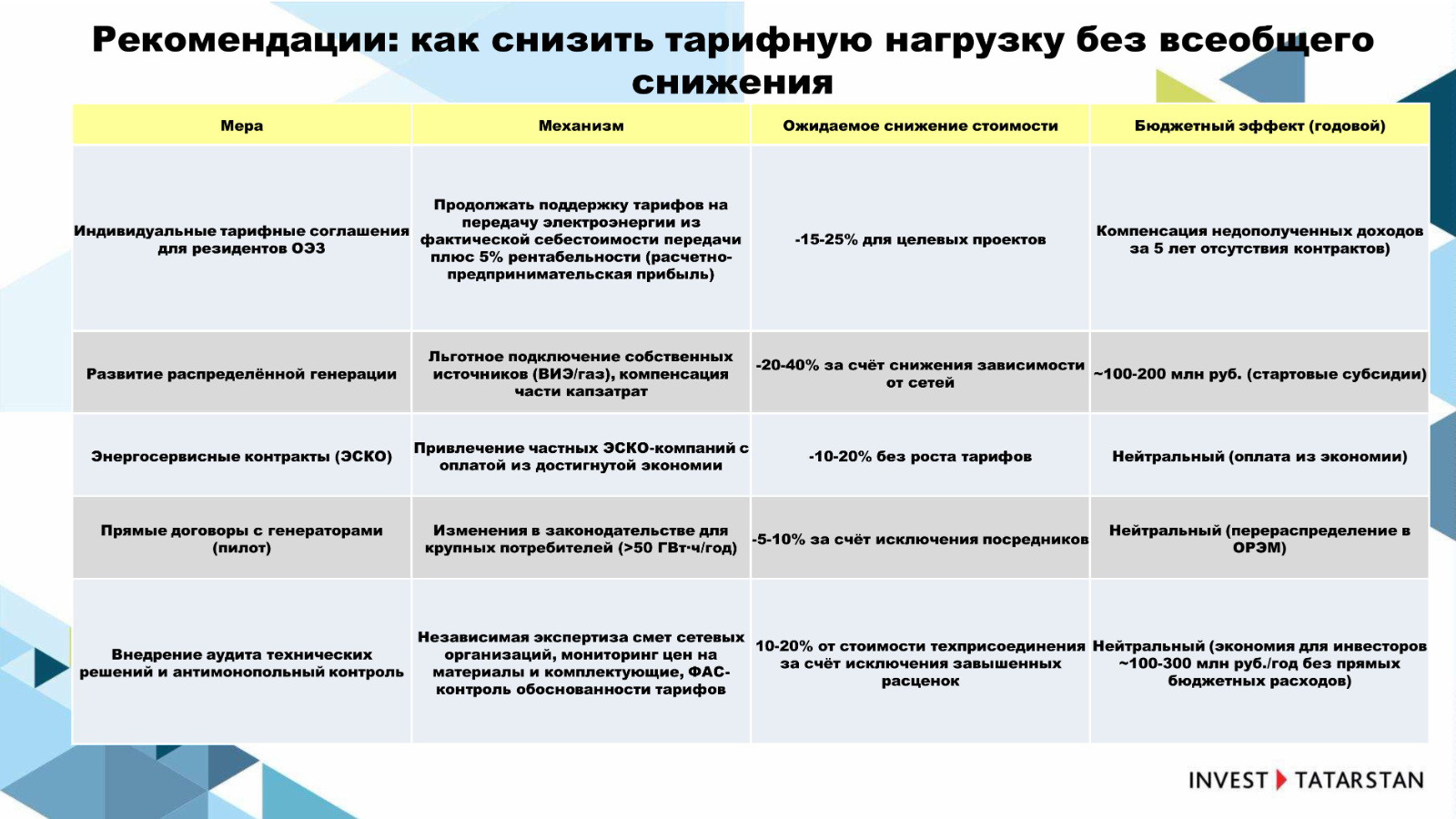
Recommendations: how to reduce the tariff burden without universal reduction .
Talia Minullina:"What can be done? A general reduction in tariffs is impossible without endangering the reliability of the energy system. Therefore, we propose point-based mechanisms."
1.Individual tariff agreements for SEZ residents: reduction by 15-25% for targeted projects through the formula "cost of transfer plus 5% profitability".
2.Development of distributed generation: preferential connection of own sources, compensation of part of the capex, reduction by 20-40% due to reduced dependence on networks.
3.Energy service contracts: attracting private companies with payment from the savings achieved, a 10-20% reduction without tariff increases.
4.Direct contracts with generators in pilot mode for large consumers over 50 GWh per year: reduction by 5-10% due to the exclusion of intermediaries.
5.Implementation of audit of technical solutions and antimonopoly control: Independent examination of estimates of network organizations, monitoring of prices for materials and components, FAS-control of the validity of tariffs.
Priority areas for the development of energy efficiency in the Republic of Tatarstan.
First, data centers and digital infrastructure. Demand is over 256 MW of capacity, with demand growth of 20-30% per year. Potential partners: Masdar, ACWA Power. Format: PPP with payback guarantee.
Second, energy efficiency in the petrochemical industry. Modernization of thermal power plants, utilization of associated petroleum gas, cogeneration. Partners: TAQA, Saudi engineering companies. Format: energy service contracts with cost sharing.
Third: pilot projects of green hydrogen. Export diversification, fulfillment of climate commitments. Partners: NEOM Green Hydrogen, Masdar. Format: a joint venture with an export orientation to the EAEU and Asia.
Recommended strategies:
1. Rather than strive for massive tariff reductions, we should introduce targeted mechanisms to support priority projects: SEZs, data centers, and export-oriented industries.
2.Focus on technological localization and high—value-added projects, where tariff is not the only competitive factor.
3. To use the institutions of PPP and energy service contracts to attract Middle Eastern capital without direct budget financing.
4.We should start with pilot projects in the field of digitalization, energy efficiency and distributed generation, where regulatory barriers are lower and the demonstration effect is higher. The entry potential for major Middle Eastern players is 4-25 billion rubles per project, which corresponds to 0.1-0.3% of their portfolios.
Talia Minullina: "Let's face it. We are facing serious challenges. Connection tariffs have increased by 137.5% in five years. Cost excess over neighboring regions by 20.9-25.5%. Four suspended projects with a total volume of 2,265 million rubles of unrealized investments. These are jobs that have not been created, and taxes that have not been received by the budget. But! Despite these problems, Tatarstan has significant potential. The second place in the National rating of the investment climate. Developed infrastructure. High access to gas. Institutional support. Openness to projects in the field of renewable energy sources. The implementation of the proposed point support mechanisms will reduce the tariff burden by 10-40% for priority projects without compromising the reliability of the energy system. Partnership with the countries of the Middle East, the introduction of energy service contracts and distributed generation are all real tools that can be launched as early as 2026. The time to act is now. Only a combination of commercial projects with infrastructural and social initiatives will reduce risks and increase the sustainability of the partnership. Tatarstan has all the necessary competencies to become a leader in this transformation."